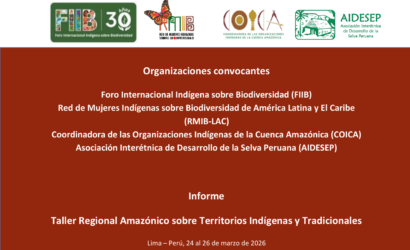
The workshop will bring together experts from Indigenous Peoples of the Amazon region to exchange experiences and knowledge on the vital role of Indigenous and Traditional Territories (ITT) in biodiversity conservation.
The workshop aims to exchange experiences of Indigenous Peoples to participate in the implementation of the new Programme of Work on Article 8(j) of the Convention on Biological Diversity (CBD), focusing specifically on Tasks 1.1 and 1.2. Likewise, participants will analyze the results of the negotiations from the first meeting of the Subsidiary Body on Article 8 paragraph j) on traditional knowledge (SB8J-1) to prepare their advocacy for upcoming global meetings: the 28th meeting of the Subsidiary Body on Scientific, Technical and Technological Advice (SBSTTA-28), and the 17th meeting of the Conference of the Parties to the Convention on Biological Diversity (COP-17) from October 19–30, 2026, in Yerevan, Armenia.
The global recognition that Indigenous Peoples conserve biodiversity in their ancestral territories through their own governance systems—a key element for the new global conservation paradigm—will be addressed.
The Workshop will include presentations by experts from indigenous organizations such as AIDESEP (Peru), OPIAC (Colombia), CONFENIAE (Ecuador), COIAB (Brazil), and COICA. It will also feature presentations from representatives of the Ministries of Environment of Peru and Colombia.
This workshop takes place at a strategic moment. Following the progress made in previous meetings, the focus now is to consolidate the implementation of the new Programme of Work on Article 8(j), specifically Tasks 1.1 and 1.2, which directly link the recognition of territories with nature conservation. Lima represents a crucial stop to analyze the results of the SB8J-1 negotiations and to unify the voice of Amazonian Indigenous Peoples ahead of the upcoming SBSTTA-28 and COP-17 negotiations in Armenia. It is an unprecedented opportunity to ensure that international biodiversity governance faithfully reflects the contributions and territorial rights of Indigenous Peoples.
About
Objectives
The main objective of the Workshop is to exchange experiences and develop recommendations on the contribution of Indigenous and Traditional Territories (ITT) of Amazonian Indigenous Peoples, for their effective contribution to the fulfillment of Target 3 of the new Kunming-Montreal Global Biodiversity Framework, as well as Tasks 1.1 and 1.2 of the new Programme of Work on Article 8j (PoW8j), and to analyze the results of the SB8J-1 negotiations with a view to the SBSTTA-28 and COP-17 negotiations in Armenia.
Why is it important to discuss ITTs now?
Indigenous and Traditional Territories (ITT) are vital for the health of the planet and climate balance, harboring the Earth’s richest biodiversity under knowledge systems that have protected ecosystems for generations. In the current context, it is fundamental that global biodiversity policies fully recognize and support indigenous governance, rights, and stewardship. This dialogue positions ITTs as a distinct and legitimate conservation pathway that operates effectively beyond traditional frameworks like Protected Areas or Other Effective Area-based Conservation Measures (OECM).
Recomendación adoptada por el Órgano Subsidiario sobre el Artículo 8 j) y Otras Disposiciones del Convenio sobre la Diversidad Biológica Relativas a los Pueblos Indígenas y las Comunidades Locales el 30 de octubre de 2025.
Any media enquiries should be directed to iifbcomms@iifb-indigenous.org
Photo Credits: ITTs Workshop
We use cookies to ensure that we give you the best experience on our website. If you continue to use this site we will assume that you are happy with it.